
FREE MASTERCLASS
I’m hosting a free live masterclass to show you:
How to Buy a Profitable Small Business (That You Don’t Regret Buying and Doesn’t Take Up All Your Time)
We’ll cover where to look, how to tell a good deal from a money pit, and how people actually pay for these things.
Come with questions for the Q&A after.
You’re Playing the Wrong Game
Chamath Palihapitiya, venture capitalist and All-In podcast co-host, posted this a while back, and it’s been living in my head rent-free.

It’s not often people that smart change their positions on something. So when they do, you better pay attention.
He says America has pulled the progress of people who own assets so far apart from the progress of people who earn wages that the headline numbers about the economy can't tell you who's getting ahead anymore.
I've been shouting this from the social media rooftops, but it hits different coming from a guy who made his fortune on the asset side.
So let's check his math.
The top 1% of American households now hold 32.5% of all household net worth. That's the highest share in the Fed's quarterly data, which starts in 1989.
Stocks are even more lopsided. The top 10% of households own about 87% of all stocks and mutual funds. The bottom half of the country owns around 1%.

So the next time a headline says "markets hit a record," translate it. About 87 cents of every dollar in stock gains lands with the top 10%.
Now let’s look at wages. Deep breath, ‘cuz it’s a doozy.
From 1948 to 1979, worker productivity and worker pay climbed together. Then they split. Between 1979 and 2018, productivity grew about 70% while typical worker compensation grew about 12%.
Workers got A LOT more productive, but their paychecks didn’t keep up.

Maybe that's you.
You show up. You hit your number. You got the 4% “inflation” raise and said thank you. But it still feels like you're on a treadmill that someone keeps cranking faster. You can’t help but feel something about this whole arrangement smells like bad sushi.
Your gut's right about that.
The two games
The American economy tracks 2 scoreboards.
The first one tracks wages, and the only ways to move it are working more hours or getting someone's permission.
The second one tracks assets. Equity in a company, a building, a business you own. Those can grow in value regardless of how much time you spend on them.
But when you see CNN report on how well the economy is doing, it doesn’t separate the asset class from everything else. So while you can see “the economy” going up, you might still feel the pain at the gas pump or grocery store.
And the tax code makes the gap wider. On Joe Rogan's show in May, Chamath laid it out. Earn a big income as a wage earner and close to half of it can go to taxes. Earn the same amount through capital gains and you pay about half that rate.
And if you own a business, you might pay even less.
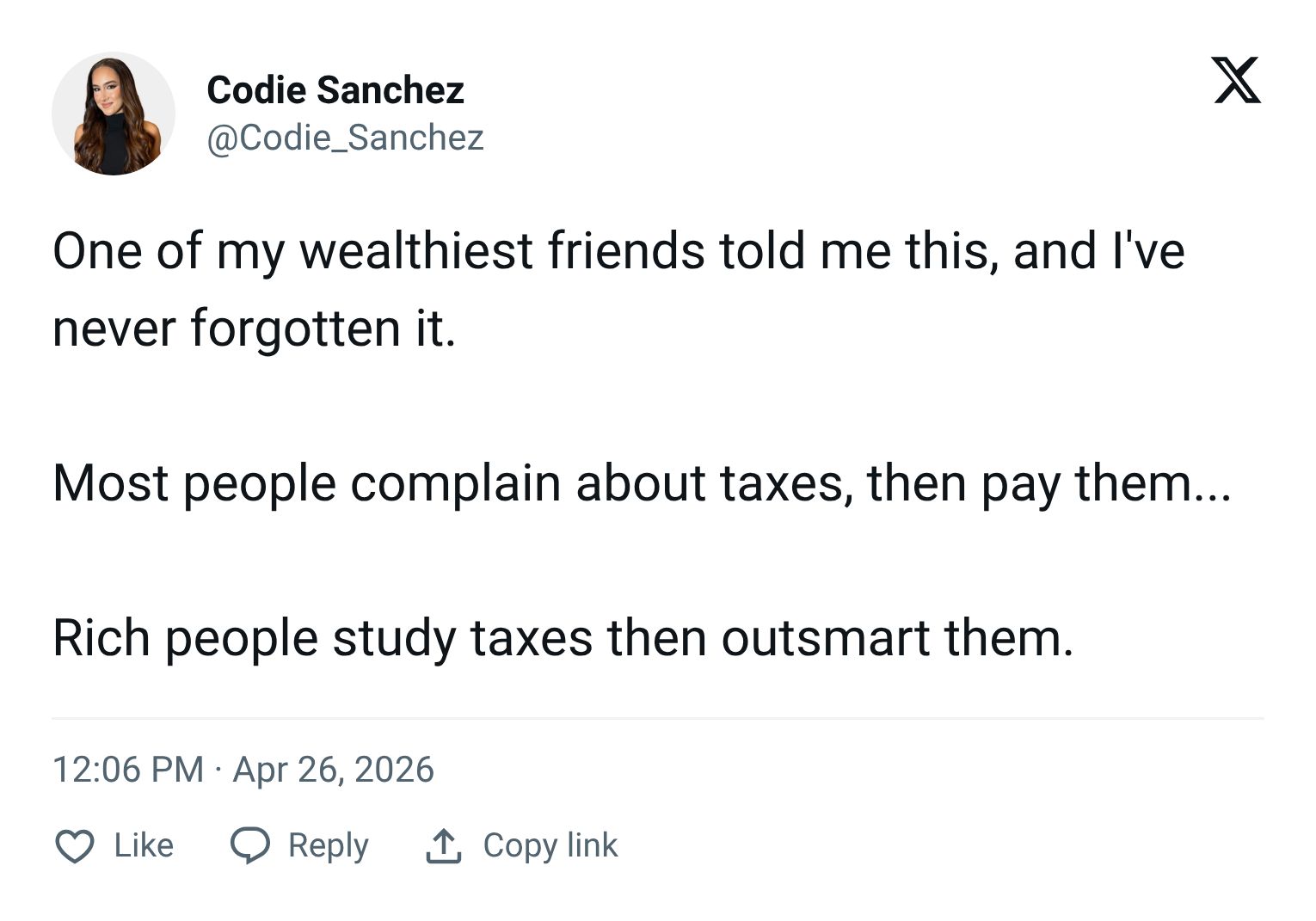
Same dollars, different scoreboard, different rules, different game.
I'm not telling you that so you'll get mad. (Cool if you do. Use it as fuel to build something.) But mad doesn't pay the mortgage.
Chamath's point is that the 2 boards got disconnected, but I think it just highlights a bigger problem…
You never knew what game you were supposed to be playing.
So now you have a choice to make. Own, or be owned.
THE OWNERSHIP CHEATSHEET
Here's a 2-minute check on where you stand. Give yourself 1 point for every yes.
Do you own a piece of something real, like a business or a deal, beyond what's in your 401(k)?
If you stopped working for 90 days, would anything you own still be producing income?
Did any of your net worth growth last year come from somewhere other than the money you saved from your paycheck?
Could you run a whole business, not just a department?
Do you personally know 3 business owners over 60?
0–1: You're fully on the first board. Plenty of smart people start right there. Start with question 5, because relationships come before deals.
2–3: You've got a foot on both boards. Next, turn your skill into a stake. Ask for equity in place of the next raise, or partner with an owner who needs exactly what you're good at.
4–5: You're an owner. Go pull somebody else across.
Most people who take this score a 0 or a 1. I'd bet a lot of the people reading this newsletter did too.
That's fine. A low score just tells you where to begin.
If you already own a business, you're on the second board, but some owners still feel more like employees of their business than owners of it.
Sound familiar?
If your business is doing $500K or more, but you still feel more like an employee, consider this your personal invite to the Growth Accelerator.
Every month, we’re sitting down in-person to troubleshoot your biggest business roadblocks, and give you a personalized 90-day action plan to grow.
It’s pretty intense, and we don’t take just anybody.
So if all that doesn’t scare you, hop on a call to apply.

Put down the pitchforks…
When people hear "asset owners," they picture hedge funds and tech founders in vests twirling their mustaches and hoarding wealth. Or the demonized billionaire class that so often gets painted as the scapegoat taking your hard-earned dollars.
These images rile people up and sound the call for “redistribution,” or worse, entice the disenfranchised to burn it all down…
But the truth is, they’re not evil. They’re just keeping score on the second board. And a lot of that game is getting played on your local town square.
So again, you can be mad. But why not just join the game?
McKinsey estimates that about 6 million small and midsize businesses will face an ownership change by 2035 as baby boomers retire. More than 1 million of them are viable to sell, with up to $5 trillion in combined enterprise value.
Project Equity puts it another way. Boomers getting ready to retire own about 2.3 million small businesses, and those businesses account for 1 in 6 jobs in the country.

It’s called the Silver Tsunami, and it’s VERY REAL.
(It’s also one of the highest-leverage opportunities of our generation.)
Picture an HVAC company that's run your street for 31 years. The owner is 67. He’d like to pass the company down, but his kids live out of state and don't want it. He's got trucks, techs, and a customer list longer than your arm.
He also has no plan.
Somebody's going to end up with that business. It might be a private equity roll-up, a competitor, or it might be you.
Nothing is keeping you from getting in the ownership game, except fear and lack of knowledge. And if you’d like a little dose of courage, I’d love to teach you exactly how I find, fund, and buy businesses HERE.
Because this is one of the biggest ownership handoffs this country has seen, and most people will only ever read about it in the news.
Chamath thinks this split between owners and wage earners will decide every election from here on out. And he might be right. I have no effin’ clue.
But I do know that while politicians argue about how to slice the pie for the next 20 years, owners will spend that time putting up numbers on the asset board.
The economy didn't stop working.
It’s just proving what we talk about at Contrarian Thinking all the time. Ownership is the future.
So go own something.
-Codie
What’d you think of this week’s newsletter?
Hit reply to let us know. How ya feeling? Did we crush it? Blow your mind? We read every response.
Want more where that came from?
Head to our website to learn more about our programs.

